Protecting Cargo in the Hold
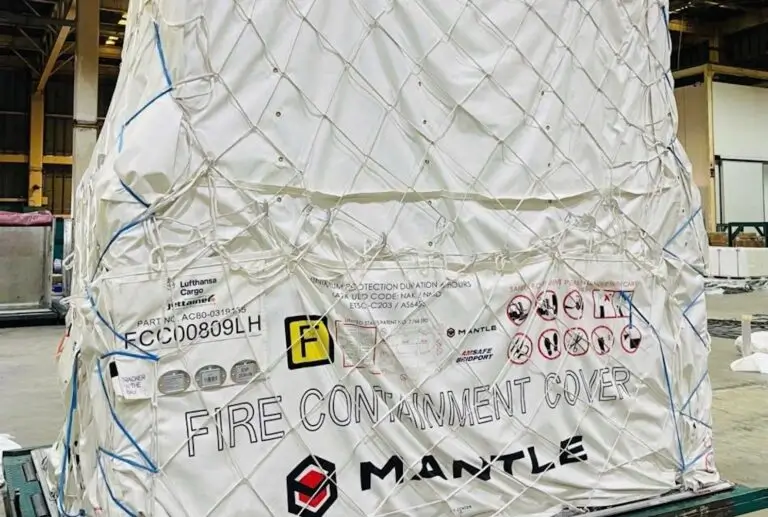
- Rising air cargo volumes — particularly lithium-ion battery shipments — have intensified the risk of thermal runaway events, shifting fire containment from contingency planning to frontline defence. AmSafe Bridport has expanded beyond traditional Class A covers to a portfolio of Fire Containment Covers, Bags and Pouches engineered with flame- and heat-resistant materials, controlled smoke release, and reinforced structural seams to prevent fire spread and preserve critical diversion time.
- With formal lithium battery fire test standards expected in 2026, the regulatory environment is tightening. In the interim, airlines are driving higher performance thresholds, integrating containment systems with RFID and Bluetooth tracking to enable real-time monitoring and layered protection strategies that combine onboard suppression, detection and physical isolation.
- The sector is moving from reactive deployment to baseline installation of fire containment as standard cargo safety equipment. Future development is focused on lightweight, high-temperature-resistant materials and intelligent, connected systems that merge advanced material science with live data, creating adaptive and resilient in-flight fire risk management.
As air cargo volumes continue to rise—driven by electronics, e-commerce, and automotive parts—the challenge of managing dangerous goods is becoming more acute. Among the most pressing concerns is the transport of lithium-ion batteries, where incidents involving thermal runaway are forcing the industry to rethink its approach to in-flight fire safety.
Thermal runaway, often triggered by damaged or defective cells, can escalate rapidly within dense cargo loads. As a result, containment is no longer viewed as a contingency measure but as a primary line of defence.
“Something as simple as a single cell can trigger a cascading fire or explosion within a tightly packed cargo environment,” says Natalie Paul, Vice President of Sales and Engineering at AmSafe Bridport. “The industry is no longer asking whether a fire can occur, but how best to contain and survive one in flight.”
AmSafe Bridport, a long-established developer of fire containment solutions, has seen customer requirements evolve well beyond traditional Class A fire covers. Its portfolio now includes Fire Containment Covers, Bags, Pouches, and Container Fire Containment Covers, designed to protect everything from palletised freight to individual parcels.
According to Paul, material performance is central to effective containment. “All materials used in our Fire Containment Covers are flame- and heat-resistant,” she explains. “The design allows controlled smoke release so that aircraft smoke detection systems remain active during a fire, while external temperatures remain low enough to prevent spread to adjacent cargo.”
Structural integrity also plays a critical role. Fire-resistant threads and carefully engineered seam placement are used to isolate vulnerable areas from direct flame exposure. Ongoing collaboration with suppliers supports the development of bespoke materials intended to address emerging risks.
New fire standards on the horizon
Many fire containment solutions currently in service have been developed in the absence of formal regulatory standards. That situation is expected to change in the near term.
“We are actively involved in the development of new lithium battery fire test standards,” Paul says. “Once these are released in 2026, all of our products will be re-tested to ensure full compliance.”
Until then, operator expectations are shaping product development. Airlines are increasingly seeking solutions that not only perform under extreme conditions but also integrate with broader fire detection, tracking, and response systems.
“More operators are integrating Fire Containment Covers with RFID and Bluetooth tags to enable real-time monitoring,” Paul notes. “By combining onboard suppression with physical containment, a multi-layered defence strategy becomes possible.”
While details of operational fire incidents are typically confidential, AmSafe Bridport points to extensive controlled testing to demonstrate performance.
“These tests consistently show that effective containment can prevent fire spread, limit structural damage, and preserve critical time for diversion,” Paul says. “They reinforce the idea that containment is not a last resort, but a core risk-management tool.”
From equipment to implementation
Even the most advanced containment systems are only effective when used correctly. To address this, AmSafe Bridport supports customers through hands-on training, global maintenance services, and detailed digital guidance covering installation, removal, and repair.
“Operators are under pressure not just to have the right equipment, but to use it consistently and correctly,” Paul observes. “The goal is to make implementation as straightforward as possible, wherever operations are based.”
Across the sector, a more proactive approach to cargo fire safety is taking hold. Fire covers are increasingly being adopted as standard equipment rather than deployed only in response to specific threat assessments.
“Many airlines are now installing Fire Containment Covers as part of their baseline cargo safety setup,” Paul says. “There is a clear and accelerating shift towards prevention and resilience.”
Regulators are beginning to reflect the same mindset, with emerging rules placing greater emphasis on early intervention and in-flight survivability.
Designing for the unknown
Behind the scenes, engineers face a complex balancing act: developing containment solutions that are lightweight, durable, cost-effective, and capable of withstanding extreme temperatures.
“Combining all of those requirements is challenging,” Paul admits. “Cargo profiles are evolving quickly, particularly with new battery chemistries and higher energy densities. These introduce fire behaviours the industry has not encountered before.”
For that reason, continued investment in material science remains a priority. “New lightweight materials and manufacturing techniques are essential,” she explains. “The aim is to improve performance margins while making products easier and faster to deploy.”
Looking ahead, fire containment is expected to become both smarter and more connected. The future, as Paul describes it, lies in layered and intelligent systems that combine advanced materials with real-time visibility.
“By integrating physical containment with data and monitoring, cargo fire safety becomes more adaptive and more resilient,” she says. “That approach will be increasingly essential as risks continue to evolve.”